


Search results

With the densification of data everywhere in the network (backbone, backhaul, middle-haul and fronthaul), using one fiber per service is not the best use of resources. Multiplexing multiple services through the same fiber is more efficient in transporting data from point A to point B, while providing a sustainable and evolutive path moving forward. Key takeaways: The current array of WDM technologies Key xWDM signal parameters that require testing Stay tuned for Part II which will cover WDM applications in 5G optical access networks.
Resources
With the many disruptions COVID-19 posed to our daily routines and the way we do business, the increased demand for connectivity is pressing service providers to ensure quality network access to their subscribers. Notions of “normal” network behavior with capacity and performance expectations during “busy hours” or in “traffic centers” have all been disrupted, highlighting the need for change in the way operators manage networks. Moreover, the need to virtualize networks while deploying new 5G use cases with stringent SLAs magnify the complexity of assuring the quality of experience delivered to customers on existing and future networks. In this webinar we will discuss how an Adaptive Service Assurance approach through real-time analytics, end-to-end monitoring (RAN to Core), ML/AI automation, and a multidomain smart data collection and processing would allow rural operators to swiftly adapt to the rapid rate of technological change, growing customer expectations, and budget constraints in a competitive market. Key takeaways: Actionable Insights: Maximizing the benefits from your existing investment in service assurance Smart Monitoring: probe-less, probe-based and on-demand data capture Convergence: Conglomeration of Active and Passive monitoring E2E: Multi-domain service assurance (RAN / Core / Transport) Power of AI/ML: Embedding telecom expertise in an AI/ML-powered service assurance solution
Resources
Vous souhaitez en savoir plus sur les solutions offertes par le FTTx pour les entreprises? Nouvelles offres et technologies, méthodes d'installation et de test, success stories? Ce webinaire est fait pour vous! 9h30 : Introduction, présentation de BICSI - Gautier HUMBERT, Président de BICSI Europe Occidentale 9h40 : La pérennité du FTTH - Philippe FOUET, Directeur Technique, Cercle CREDO 9h55 : Le POL (Passive Optical LAN) ou les bénéfices de l’architecture FTTH au sein des bâtiments intelligents - Remy DOLECKI, DC / IBN Sales Manager France & Switzerland, CORNING 10h30 : Introduction au FTTO et retour d’expérience Waycom - Géraud DANZEL D'AUMONT, Sales Manager Western Europe, NEXANS Advanced Networking Solutions 11h05 : Pause pour les participants - 5 minutes 11h10 : Optical LAN, a better way to structure the network - Hervé GAUDILLAT, Fixed Networks Business Development, NOKIA 11h45 : Limite de la mesure en réflectométrie classique : Comment augmenter la fiabilité des mesures pour les clients FTTE ? - Romain LEMOINE, Channel Manager, EXFO 12h20 : Le mot de la fin - Thierry BESREST, Président de BICSI France
Resources
Despite the COVID-19 pandemic, emerging markets are seeing tremendous growth and transformation, thanks to 5G's support for heterogeneous mobility networks with advanced distributed cloud services that combine wireless networks with an agile, virtualized and software-defined edge cloud. In turn, 5G's growth is driving the need for such approaches as edge computing architectures, which place compute, storage and connectivity close to the data sources, either near or at the access network edge. Unlike prior generations of wireless technology, 5G relies on strong, distributed cloud foundations of network and compute to power new market growth. Low latency, high bandwidth, trusted computing and storage rank are all core benefits of edge computing solutions. As a result, edge computing enabled with 5G can open up vast opportunities for application developers in manufacturing, gaming, automotive and other industries. Service providers can deploy edge computing to enable specific services, applications and use cases. For this reason, edge architectures must be redesigned to meet the stringent SLAs (Service Level Agreements) of emerging applications, detect problems early and prevent service outages. Indeed, the combination of 5G and the Internet of Things (IoT) will foster new applications that need connectivity not just between people, but also between things. Edge computing, with its new reference design, will also tap into embedded machine learning systems and artificial intelligence back-end modules to empower network intelligence and boost service agility and deployment. Open source technologies and open white-box network elements will provide key software and hardware components for these reference designs. AI/ML can also play a significant role in improving network operations, especially at the network edge, and create new service opportunities. Key takeaways from this webinar will include: Edge computing with next-generation 5G technology. Edge computing use cases with 5G technology. Open source and standards for edge computing. Next-generation edge reference architectures. Edge deployment considerations. AI/ML-powered adaptive assurance for edge computing deployments.
Resources
This educational webinar covers the generation and professional reporting of field results after performing fiber-related tests using an OTDR. Join speaker Kevin Peres as he walks you through the workflow of test data reporting using EXFO’s FastReporter, importing OTDR/iOLM traces, cleaning up the data, analyzing the results, and generating custom Excel and PDF deliverable closeout package reports. Key takeaways: Import of OTDR SOR and EXFO format traces Cleaning up identifiers and naming convention Analyzing and validating results Matching files from multiple test types Generating custom closeout packages.
Resources
Vous êtes un acteur concerné par le déploiement du Fibre to the Home (FTTH)? Vous souhaitez en savoir plus sur la méthodologie, les normes et les dernières technologies associées? Ce webinaire est fait pour vous! 9h30 : Introduction, présentation de BICSI - Gautier HUMBERT, Président de BICSI Europe Occidentale 9h40 : Présentation du nouveau Guide Pratique au réseau en fibre optique FttH dans le parc immobilier existant - Didier CAZES, Rapporteur du Groupe de Travail "Bonnes pratiques professionnelles", OBJECTIF FIBRE 9h55 : Solutions techniques innovantes pour le raccordement client - Arnaud LE DISSEZ, Responsable Produits Connectivité, Solutions Telecom Europe du Sud, PRYSMIAN GROUP 10h30 : Tests de la zone verticale : Quelles bonnes pratiques pourrions nous adopter pour réduire les réinterventions ? - Romain LEMOINE, Channel Manager, EXFO 11h05 : Pause pour les participants - 5 minutes 11h10 : Soudure optique : des évolutions technologiques pour diminuer son taux de reprise et augmenter ses performances. Réalité sur la soudure entre fibre FTTH (G657A2) et fibre réseau (G652D) - Mathieu HUSSON, Président fondateur d’INFRACTIVE 11h45 : Le mot de la fin - Thierry BESREST, Président de BICSI France
Resources
In data center environments, an increase in density can bring important benefits to operators. To support high-density data centers, new ultra-small form factor fiber connectors (USFF) such as SN and CS are gaining popularity amongst both datacom and telecom operators. Transceiver types with these connectors have been adopted by QSFP-DD, OSFP and SFP-DD Multi Source Agreement groups (MSAs) to increase bandwidth and at least double the density in order to address the need for ultra-high density optical interconnectivity demands of enterprise and hyperscale data centers. As a result, new fiber configurations are emerging to support new connector types such as Leaf and Spine. These connector types are emerging as the interconnect of choice. As industry standards continue to evolve, new duplex connector types are joining 400G breakout applications. And data centers are looking to adopt emerging trends to add flexibility in network cabling design and deliver on high-speed migration inside the data center. Key takeaways CS and SN history, standards and applications QSFP-DD/OSFP and SFP-DD transceiver overview fiber testing best practices protocol testing 2x100GE and 4x100GE breakout cables Listen to this webinar, jointly hosted by EXFO and Senko, and learn how next-generation data centers can both future-proof themselves against inevitable increases in demand and ensure network reliability.
Resources
Where are we with fiber to the home deployment? Let’s say that we have passed the 50% mark and it took us 15+ years…. Access to a Broadband internet connection is a fundamental right in our society and we cannot wait for another 15 years. The first 50% of deployment focused “low hanging fruits” but the next one will require more investment, needs to be easier, faster, and ultimately more cost effective. In this webinar we will explain what are the 3 solutions that could be implemented in order to achieve these goals: Centralized testing using OTDR technology for highly controlled build out leading to self-install capabilities and 24/7 monitoring. Field automation: accelerate network readiness and time to revenue, validate in real time the progress and the quality of deployment. Optical Fiber multimeters at work on FTTx deployment: empowering the tier one technicians, reduce truck rolls, escalation to tier 2 technicians, increase Quality of deployments.
Resources
This educational webinar covers testing, analysis, troubleshooting, and reporting using an OTDR. Join speaker Kevin Peres as he walks you through the fiber testing fundamentals (e.g., what is pulse width) before taking on more advanced issues such as ensuring that the OTDR is set up properly and how to validate the results onsite. In the next instalment, Kevin will cover best practices when it comes to saving and reporting field test results. Key takeaways: OTDR setup Splice and connector critical parameters Trace interpretation and advanced troubleshooting Validation; getting it right, the first time Trace identification, test result saving and reporting
Resources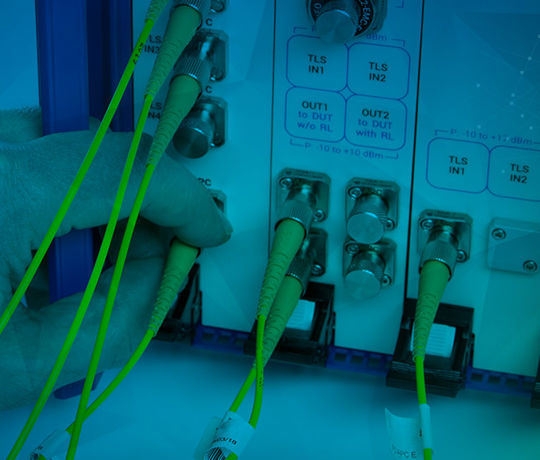
5G telecommunication infrastructures around the globe rely heavily on photonic components, such as integrated photonics. These cutting-edge optical devices are present not only in the telecom landscape but are also considered for sensing, medical or quantum computing applications. The spectral characterization of such components calls for new cutting-edge testing capabilities, going up a gear in testing speed without any compromise on accuracy or resolution. In this presentation, I will showcase EXFO’s series of spectral testing solutions for active and passive optical components. I will focus on the CTP10 component testing platform, which is a fully integrated solution for spectral characterization. The latest modules available on the platform measure insertion loss and polarization dependent loss over an unprecedented wavelength range. Key takeaways: High speed measurement with high accuracy and repeatability Integrated, easy to setup IL PDL solution Full telecom wavelength range Automation examples
Resources