

Search results

This video will guide you through the graphical user interface (GUI) of the CTP10, which is EXFO’s high-end measurement platform for spectral characterization of passive optical components. The CTP10 greatly simplifies swept insertion loss (IL) and polarization dependent loss (PDL) measurements. Watch how to configure, start and analyze measurements within minutes.
Resources

EXFO’s helping clear the air for 5G by making RF spectrum analysis simpler, faster, better! Learn how, watch a demo of our 5GPro Spectrum Analyzer.
ResourcesIt’s a highly competitive landscape out there for contractors. What challenges do contactors face today when deploying Fiber-to-the-Antenna? This documentary-style video walks you through the best practices when deploying and testing FTTA. Get all the tips from the field experts themselves.
Resources
Who Should Attend Telcos, mobile carriers, MSOs, equipment vendors, and semiconductor vendors. Financial analysts and the media are also encouraged to attend. Free Report Everyone who registers for this webinar will receive a special report by Associate Director John Kendall. A download link will be sent to you and the report will also be available to download from the live webinar console. Key Topics for Discussion The demand for fixed wireless access and implementation timeline Key technology considerations for integrating 5G into the home The intelligent test-and-monitoring approach to ensuring great customer experience with and good ROI in a home network How to deliver and ensure a high-quality, high-bandwidth service inside the home, and a look at the services that 5G home internet can enable Answers to audience questions during live Q&A Speakers John Kendall, Associate Director - Research and Analysis, Service Provider Technology, IHS Markit Yvon Rouault, 5G Solutions Manager, EXFO Keith Russell, Head of Marketing, Fixed Wireless Access, Nokia Laszlo Gyalog, Head of Digital Home Marketing, Nokia Allen Tatara, Sr. Manager, Webinar Events, IHS Markit (Moderator)
Resources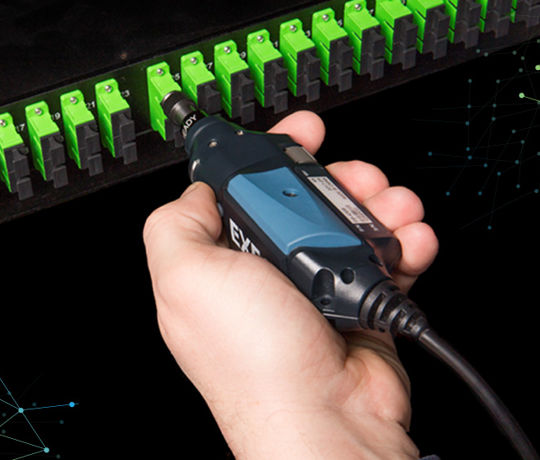
5G networks will require a lot of fiber deployed more densely and deeper into the network. While installing new fiber, or upgrading the current fiber infrastructure, connector inspection will be a priority as faulty connectors are known to be the number 1 cause of network failure. This webinar will highlight the consequences of damaged or dirty connectors and will also delve into best practices for the handling, inspecting and cleaning of optical connector endfaces. Key takeaways: The role of fiber in 5G The impact of damaged or dirty connectors Best practices: fiber optic connector inspection and cleaning
Resources
This webinar is in Spanish. FTTx networks are under continuous evolution and expansion to cover the growing demand for high speeds required by end users and the industry. Likewise, the technology continues to grow, looking for a quicker return on investment and greater simplicity in the deployment of its networks, leading to situations of FTTx networks with unbalanced splitter. Such networks bring us new challenges, whether it be during installation, activation or maintenance, to guarantee an optimal level of service for the client. In this session we will focus on the latest advances in the market regarding smart test solutions that allow the complete setup of unbalanced splitter networks in a more precise and automated way. We will also provide new developments to optimize the measurement processes in the field and management of such measurements in the cloud for a better view of the deployment in real time.
Resources
Los invitamos a esta serie de dos seminarios web, donde abordaremos la importancia de la validación de la infraestructura óptica y la transmisión de información en Centros de Datos. La disponibilidad de los Centros de Datos es fundamental. Hoy en día, tiempos muy largos de afectación suponen gastos descomunales, por lo que las instalaciones deben ser en extremo confiables. En EXFO, estamos comprometidos a ayudar a todos nuestros clientes, para que puedan ofrecer la mejor calidad de servicio y experiencia posible en sus Centros de Datos. Acompáñenos a estos 2 seminarios web. Para nosotros será un honor que nos permita mostrarle las opciones de equipos de medición y metodologías que ofrecemos, queremos ser su mejor aliado al momento de ejecutar la resolución de sus problemas, donde sea que haya fibra. Sesión 1- Mediciones de enlaces ópticos en Centros de Datos - 19 mayo. En este seminario web usted conocerá las pruebas necesarias para asegurar el correcto estado de los enlaces ópticos “intra/entre” Centros de Datos. Sesión 2 - Validación de enlaces de datos dentro y fuera del Centros de Datos, el mundo después de 10G - 2 junio. Conocerá en este seminario web las pruebas capa 2, 3 y 4 necesarias en la validación de enlaces Ethernet “intra/entre” Centros de Datos.
Resources
This session is to cover one of the most popular presentations R&M have done over the last few years around GPON, POL, PON. There are still a lot of misconceptions around Passive Optical LAN (POL) network architecture, what it is for, what it can do and how to design for it. R&M presents a complete range for POL - the space-saving and cost-efficient alternative to structured Fiber Optic cabling system. “Supported by EXFO’s expertise in specifying Methods of Procedures (MOPs) for optical and POLAN networks, both Speakers will develop these points reviewing best practices and how to avoid pitfalls”.
Resources
This webinar is presented in German. Kohärente 400G-Verbindungen werden mittlerweile in großem Umfang eingesetzt, um beispielsweise optimale Interconnect-Verbindungen zu gewährleisten. Durch den Einsatz neuer digitaler optischer Transceiver (Digital Optical Pluggables DCO) wird eine effizientere Übertragung erreicht, denn die Vorteile dieser Verbindungen sind vielfältig: größere Reichweiten, Vereinfachung des Netzwerks, Interoperabilität mit verschiedenen Anbietern, niedrigere Kosten pro Bit, Flexibilität beim Klientensignal und die lang erwartete IP over WDM-Fähigkeit. Im zweiten Teil dieser Webinar-Reihe demonstrieren wir eine echte kohärente Verbindung und die wichtigsten Elemente, die damit im Zusammenhang stehen. Sie erfahren außerdem mehr über die kohärente 400G-Technologie im Detail: Kohärente Verbindungsstandards: 400ZR, OpenZR+ und OpenROADM Vielseitigkeit der Reichweiten, Vorwärtsfehlerkorrekturvarianten und Kliententypen Welche Elemente müssen validiert werden: Validierung und Einsatz von Transceivern Verbindungsstabilität Typische Anwendungsbeispiele
Resources