


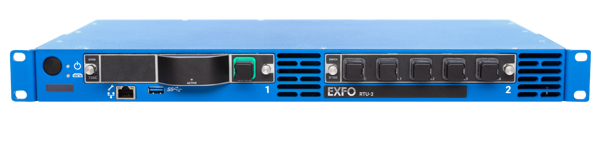
| OTDR modules — FTBx-735C-SM7R and FTBx-750C-SM3 | |
| Wavelength (nm) | 1650 (FTBx-735C-SM7R); 1310/1550/1625 (FTBx-750C-SM3) |
| Internal filter for in-service testing | Yes (FTBx-735C-SM7R); No (FTBx-750C-SM3) |
| Dynamic range at 20 μs (dB)a | 41 (FTBx-735C-SM7R); 45 (FTBx-750C-SM3) |
| Event dead zone (m)b | 0.6 (FTBx-735C-SM7R); 0.5 (FTBx-750C-SM3) |
| Attenuation dead zone (m)c | 2.5 (FTBx-735C-SM7R and FTBx-750C-SM3) |
| PON dead zone (m)d | 30 (FTBx-735C-SM7R); n/a (FTBx-750C-SM3) |
| Sampling resolution – minimum (m) | 0.04 (FTBx-735C-SM7R and FTBx-750C-SM3) |
| Sampling points | Up to 256 000 (FTBx-735C-SM7R and FTBx-750C-SM3) |
| HRD measurement time (s)e | 5 (FTBx-735C-SM7R); n/a (FTBx-750C-SM3) |
| HRD measurement loss range (dB) | 11 to 35 (FTBx-735C-SM7R); n/a (FTBx-750C-SM3) |
| HRD minimum distance separation (m)f | 0.6 (FTBx-735C-SM7R); n/a (FTBx-750C-SM3) |
| First splitter to HRD maximum distance (km) | 8 (FTBx-735C-SM7R); n/a (FTBx-750C-SM3) |
| Source mode tone frequencies (Hz) | 270, 330, 1000, 2000 (FTBx-735C-SM7R and FTBx-750C-SM3) |
| MEMS optical switch modules — FTBx-9160 and FTBx-9110 | |
| Number of output ports | 4 (FTBx-9160); 12 (FTBx-9110) |
| Operation wavelength range (nm) | 1290–1650 (FTBx-9160); 1260–1650 (FTBx-9110) |
| Insertion loss at 1530–1650 nm (dB)g | 0.7 (FTBx-9160); 1.6 (FTBx-9110) |
| Lifetime in cycles | >1×10⁹ (FTBx-9160 and FTBx-9110) |
| Interface | SC/APC (FTBx-9160); LC/APC (FTBx-9110) |
| a. Dynamic range values are typical for a three-minute averaging time at SNR = 1. b. Typical values for event dead zone with reflectance between –35 dB and –55 dB using a 3 ns pulse. c. Typical attenuation dead zone values specified for reflectance of –55 dB. d. Based on non-reflective FUT and splitter, 13 dB loss and a 50 ns pulse; typical conditions. e. HRD measurement time excludes any networking latency and assumes a 4 km PON F2/distribution section with 20 dB nominal loss. f. Typical values assuming similar attenuation levels on both sides of the HRD point. g. Insertion loss figures are typical and include the loss of one connector. | |
| Mainframe | Quad-core Intel i7 processor, 8 GB RAM, embedded Linux |
| Front interfaces | RJ45 10/100/1000 Mbit/s management port; USB 3.0 |
| Rear interfaces | Two RJ45 10/100/1000 Mbit/s management/Ethernet ports; five USB 3.0 ports |
| Relay contacts | 3 (power, system and user configurable) |
| Storage | 128 GB internal SSD |
| Power supply | –48 V DC, 10 A (option for external AC–DC adapter for AC operation) |
| Power consumption | 25 W in idle state; 40 W typical during OTDR measurement |
| Dimensions (H × W × D, including brackets) | 44 mm × 482 mm × 262 mm (1U; 1 3/4 in × 19 in × 10 5/16 in) |
| Weight (including brackets) | 5.1 kg (11.2 lb) |
| Operating temperature | –5 °C to 50 °C (23 °F to 122 °F) |
| Storage temperature | –40 °C to 70 °C (–40 °F to 158 °F) |
| Relative humidity | Below 95 % non-condensing |