


When a submarine cable fails, the race for scarce repair resources begins.

Operators need trusted fault information to assess damage and coordinate repairs. With limited repair capacity and growing scrutiny of submarine infrastructure, getting those answers sooner matters.
Approximately 200 submarine cable faults occur globally each year, competing for about 25 dedicated repair vessels. On average, 90 days pass between fault detection and the start of repair. Repair operations can cost up to $1 million per day.
These constraints make repair readiness an operational priority. Before coordinating an intervention, operators need to locate the fault and assess the affected fiber pairs. Faster testing helps them reach those critical decisions sooner.
Why fault-localization speed matters
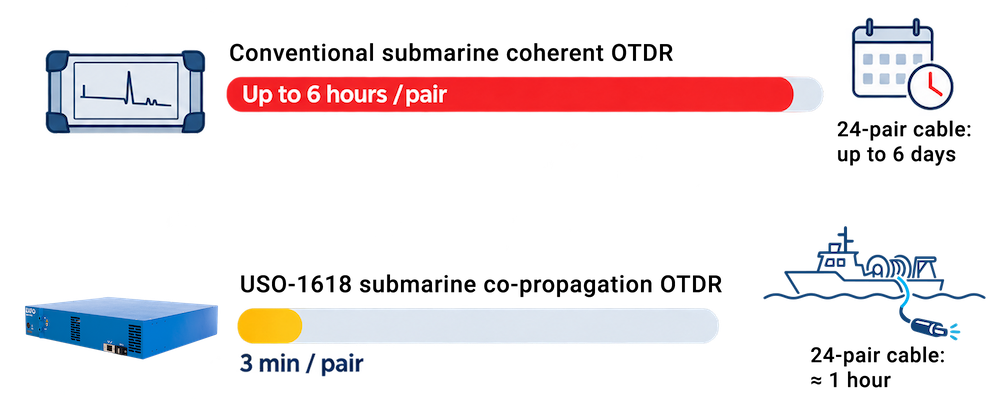
Conventional OTDR testing of amplified submarine cables can take up to six hours per fiber pair. Across a cable with many pairs, that can mean several days of testing to assess the damage.
Meanwhile, growing geopolitical concerns are putting submarine infrastructure security and network resilience under greater scrutiny. Operators face pressure to respond with both speed and confidence.
Faster fault localization shortens the diagnostic stage of the response. It gives teams the measurements they need to plan an intervention and coordinate scarce repair resources earlier.
What should operators expect from their testing strategy?
Acquisition time is only one consideration. Setup, analysis and access to results all influence how quickly teams can act.
A repair-ready testing strategy should address four needs:
- Trusted results, quickly. Measurements must locate faults with enough precision to support confident repair decisions.
- Consistent testing under pressure. Approved methodologies, parameters and thresholds should be defined in advance to reduce setup errors.
- Clear, accessible information. Automated analysis, intuitive link views and integration with cable-management systems help teams interpret and use results.
- Continuity from landing station to repair vessel. Testing should support shore-based troubleshooting, onboard measurements and repair confirmation.
The practical question is: How quickly can teams move from starting a test to having the information needed to coordinate a repair?
From days to hours
Co-propagation optical time-domain reflectometry (C-OTDR) is changing the time required to locate faults across amplified submarine cables.
EXFO’s USO-1618 submarine OTDR locates faults in three minutes per fiber pair, enabling validation of a 24-pair cable in approximately one hour instead of several days. It delivers an 18-dB dynamic range across amplified submarine topologies and fault-location resolution of approximately 5 meters.
Predefined configurations and automated analysis support the workflow, while rackmount and portable use extend it from the landing station to the repair vessel.
For operators, this means earlier damage assessment and faster repair coordination.
Readiness begins before the fault—and includes repair validation
Testing supports the entire cable lifecycle, from as-built characterization and commissioning to maintenance, troubleshooting and repairs. Planning those workflows before an incident helps teams prepare for both diagnosis and repair confirmation.
Post-repair validation is especially consequential when offshore resources are limited and costly. Teams need to confirm the repair before the vessel leaves.
Operators cannot control every delay in a submarine cable repair. They can prepare to locate faults quickly, make informed decisions and validate the work.


