


Scaling AI infrastructure: the growing role of fiber and data center interconnect

Overview
Artificial intelligence (AI) infrastructure depends on the fiber networks connecting distributed computing resources. As power, cooling, and land constraints push workloads across multiple facilities, data center interconnect, regional fiber, continuous testing, and automation become essential to scalable and resilient operations.
Why is fiber essential to AI infrastructure?
AI is redefining the scale and structure of global digital infrastructure. Although compute capacity, GPUs, and hyperscale data centers receive much attention, fiber networks determine how efficiently data moves between facilities, across metropolitan regions, and through long-haul networks.
The next phase of AI growth will depend on more than performance inside individual data centers. As compute becomes increasingly distributed, fiber connectivity provides the capacity and reach required to scale AI infrastructure.
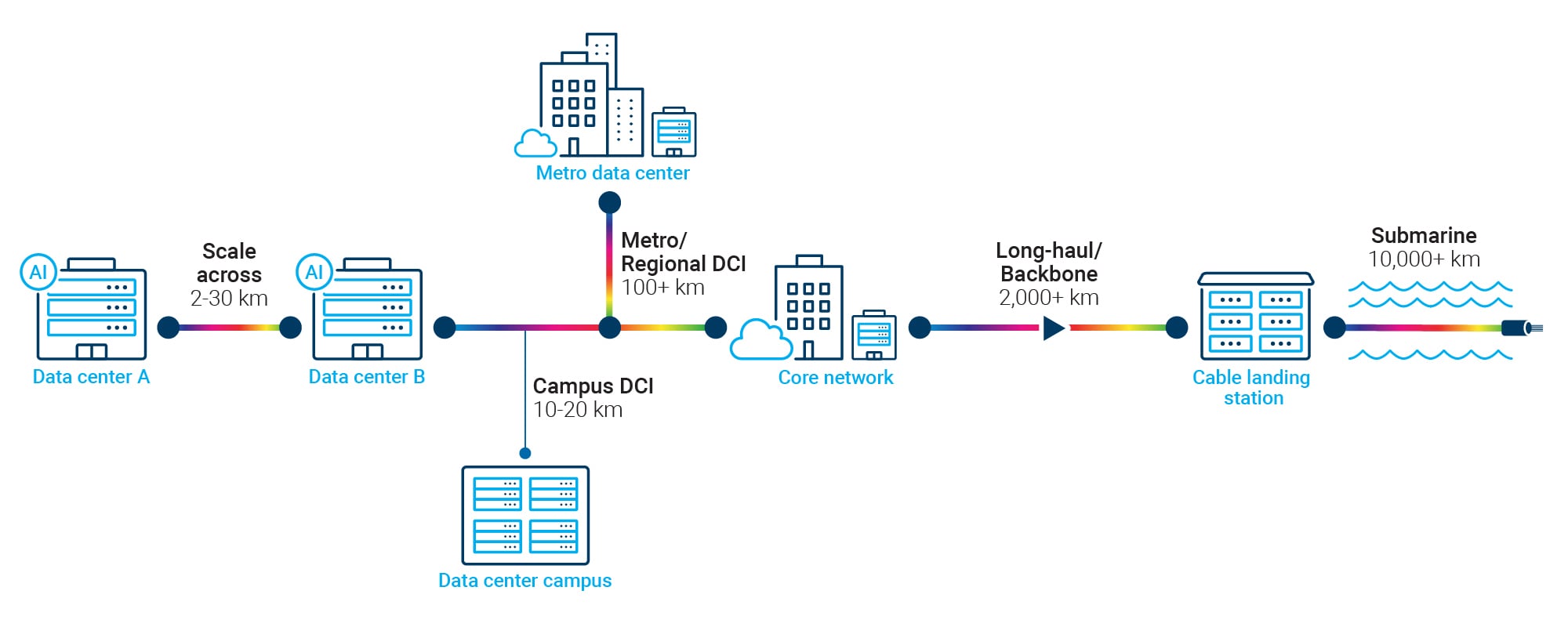
Why the shift from scaling up to scaling across the data center?
The first phase of AI infrastructure growth was concentrated inside the data center. Dense GPU clusters required high-capacity intra-facility fiber to support tightly coupled compute and extreme east-west traffic.
That model is changing. Power availability, cooling constraints, and land limitations are making it increasingly difficult to expand AI workloads within a single site.
Operators are moving from scaling up within one facility to scaling across multiple geographically separated facilities. This shift makes data center interconnect essential infrastructure for AI training, inference, and distributed cloud operations—not simply a back-end redundancy layer.
What role does data center interconnect play in AI networks?
Data center interconnect (DCI) uses high-capacity fiber links to connect separate data center facilities. These links allow workloads to span multiple sites, balance computing resources, and move massive datasets in real time.
Optical transport technology is also advancing rapidly. Networks have progressed from 100G to 400G and 800G deployments, with roadmaps extending toward 1.6T and beyond.
This progression reflects the exponential growth of AI traffic and the need for scalable, high-efficiency interconnection across cloud and hyperscale environments. Industry forecasts place the global DCI market in the mid-teens of billions, with sustained double-digit growth expected as AI workloads and hyperscale architectures increase demand for high-capacity connectivity.
Why is regional fiber becoming a strategic layer?
Regional fiber sits between metropolitan connectivity and long-haul DCI. These routes connect distributed data center ecosystems within specific geographic areas while providing additional capacity, route diversity, and operational flexibility.
New sources of fiber supply are also emerging. Utilities, rail operators, and transportation organizations are increasingly using their rights-of-way to deploy or lease dark fiber, expanding regional connectivity options and accelerating deployment timelines.
Regional fiber is evolving from a secondary consideration into a strategic enabler of distributed AI infrastructure.
What makes large-scale fiber deployment difficult?
Fiber demand is accelerating, but deployment becomes more complex as network size increases. When fiber counts grow from tens to hundreds or thousands per project, traditional deployment models begin to break down.
Manual coordination, fragmented documentation, and inconsistent field processes create inefficiencies that compound at scale. Small errors can cause significant delays and rework, including:
- Inconsistent fiber labeling
- Manual test-parameter entry
- Fragmented reporting
- Inconsistent field procedures
- Poor coordination between teams and systems
Operators are responding by automating more of the deployment workflow. Test parallelization, fiber identification, polarity validation, and standardized field execution can improve throughput and consistency.
Digitized processes also provide field teams with structured guidance on what to test, how to perform each test, and how to capture and report results. This approach reduces errors and accelerates service activation.
Why must fiber testing become continuous?
Testing is shifting from a final validation step to a continuous capability embedded throughout the deployment lifecycle.
Instead of certifying networks only after construction, operators are integrating testing earlier and more consistently. This approach helps engineer quality into the build process and identify problems before they affect activation or operations.
Testing capabilities must also keep pace with changes in scale and technology. New fiber types, including hollow-core and multicore fiber, and rapidly advancing optical transport speeds require adaptable, high-performance testing methods.
Automation and remote testing are becoming critical enablers. They allow operators to increase throughput, reduce manual intervention, and support continuous validation across large-scale deployments.
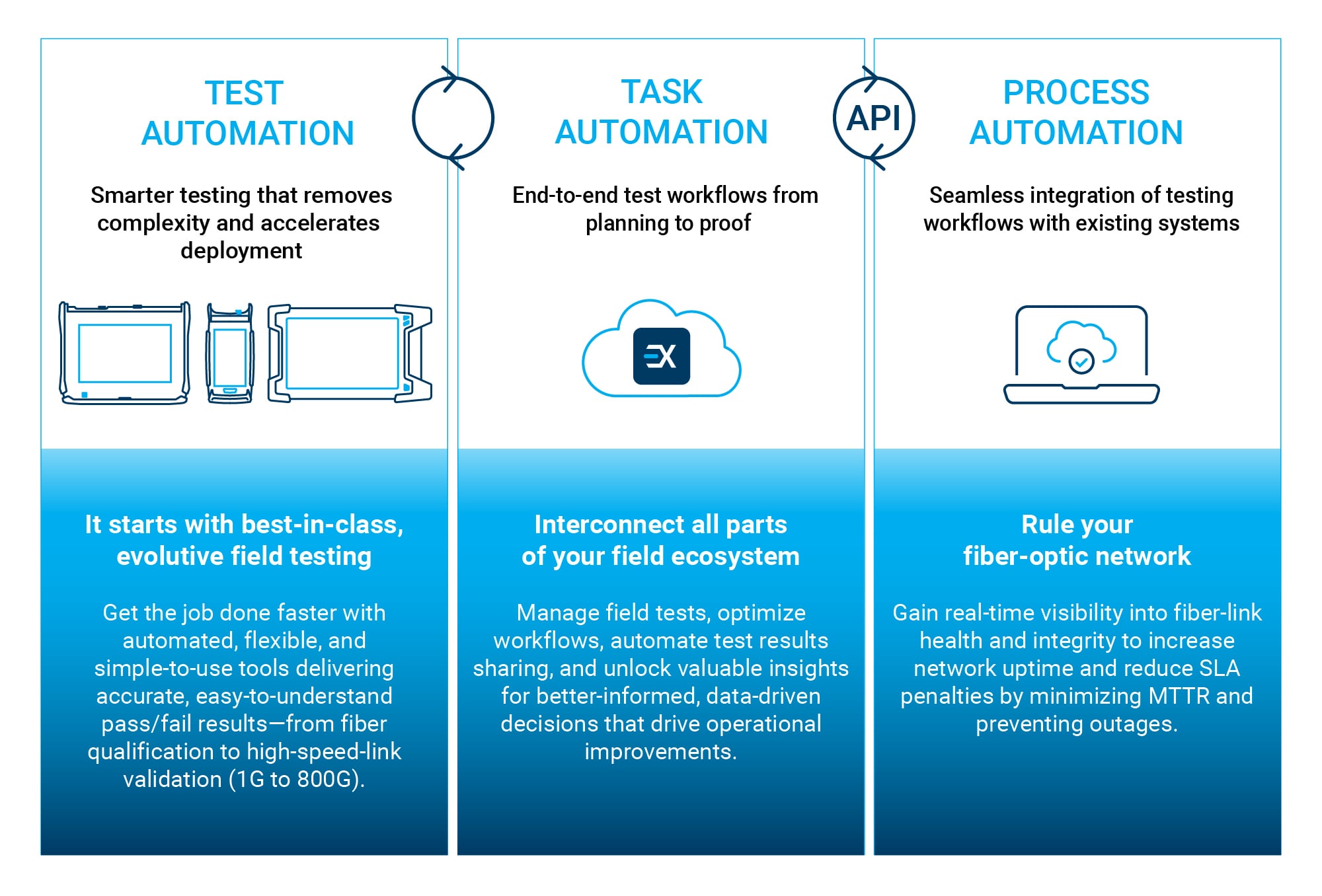
How do test, task, and process automation support DCI?
Test automation
Test automation reduces manual effort during field validation and improves consistency across large fiber deployments. Automated tools help technicians perform repeatable tests and capture reliable results across high fiber counts.
Task automation
Task automation connects individual testing activities into structured workflows. Field teams receive clear instructions about what to test, how to test it, and how to document completion.
Process automation
Process automation connects testing workflows with broader operational systems. This integration improves visibility, supports consistent reporting, and helps operators manage network quality throughout deployment and operation.
Together, these automation layers turn isolated measurements into coordinated, scalable quality-assurance processes.
How can operators build AI networks for scale and resilience?
Operators face growing pressure from fiber-supply constraints, workforce limitations, and increasing network complexity.
Long-term reliability requires more than building and certifying infrastructure once. Operators need continuous visibility into network health, automation throughout deployment workflows, and operational strategies designed to support future capacity upgrades.
Organizations that treat quality, testing, and automation as strategic enablers can scale infrastructure more efficiently and maintain resilient operations. In the AI era, fiber is no longer simply connectivity infrastructure. It is the foundation that determines how quickly innovation can move.
EXFO helps data center operators, hyperscalers, contractors, and network providers validate DCI infrastructure across the deployment lifecycle. EXFO’s fiber-testing, high-speed testing, workflow-automation, and remote-monitoring capabilities help improve deployment consistency, accelerate activation, and support resilient network operations.


