


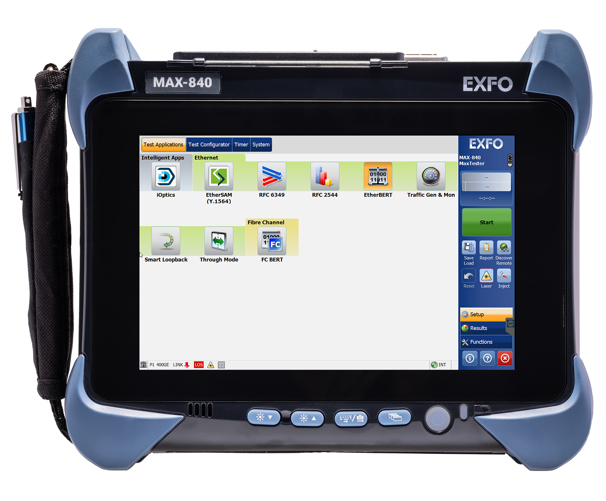
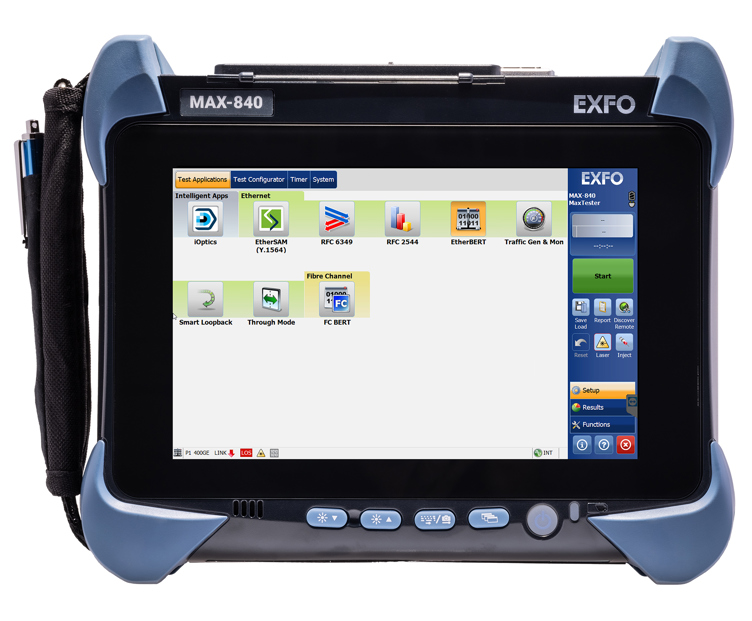
| Detailed compliance testing | IEEE 802.3ba and IEEE 802.3bs standard and IEEE 802.3ck standard |
| Multi-interface support | Pluggable MSA-compliant 2×QSFP28 transceivers AOC QSFP28/QSFP-DD/OSFP cable support QSFP-DD MSA revision 6.3, 4×100G 400G DAC cables support Pluggable, MSA-compliant 2×QSFP+ transceivers Pluggable, MSA-compliant 2×SFP28 optical transceiver Pluggable, MSA-compliant 2×SFP/SFP+ optical transceivers Pluggable, MSA-compliant 1×OSFP optical transceiver |
| Line rate | 425/212.5/106.25 (single lambda)/103.125/53.125/41.25 Gbit/s, 100G SRBD, 40G, 25G, 10G, and 1G |
| Robust physical-layer validation | 400GAUI lane-error generation and monitoring PCS lane mapping and monitoring capability Per-lane skew generation and measurement PCS error generation and monitoring per lane Full MDIO/I2C read/write access |
| Transceiver and cable validation | SFP, SFP+, SFP28, QSFP+, QSFP28, QSFP56, QSFP-DD, QSFP112 and OSFP. Also AOC and DAC cables. |
| iOptics | Optical-device I/O interface quick check Optical Tx power-level test Optical Rx signal-presence and level test Stress test Excessive skew test Temperature and power consumption monitoring Host and media loopback |
| Power measurement | Optical channel power measurement with color indicators per lane |
| Frequency measurements | Allow users to measure the received frequency per wavelength (in Hz) in the used of parallel optics |
| Frequency offset | Offsetting of the transmitted signal's clock on a selected interface, and monitoring |
| Transceiver non-blocking analysis | Enables a step-by-step monitoring of the transceiver boot-up sequence |
| BERT | BERT framed and unframed testing using different parameters and different frame sizes, including EMIX. The Ethernet BERT application also allows LLDP neighbor validation which displays the most important information forwarded by the LLDP protocol. |
| Service disruption time (SDT) | Service disruption time measurements based on no-traffic mode, with statistics including longest disruption time, shortest, last, average, count, total and pass/fail thresholds |
| Latency measurements in BERT | High-resolution delay measurements integrated in the BER with statistics including current, average, maximum, minimum, count, total and pass/fail thresholds |
| Error injection mode | Manual, rate and continuous (maximum rate) |
| Layer 2 | MAC address and Ether type edition available Q-in-Q capability with the ability to go up to three layers of stacked VLANs |
| Layer 3/4 | Source and destination IP address configuration available IP TOS/DSP configuration available UDP source and destination port configuration available |
| RFC 2544 | Throughput, back-to-back, frame loss and high-resolution latency measurements according to RFC 2544; frame size: RFC-defined or user-configurable |
| EtherSAM | Simplified ITU-T Y.1564 test that performs service configuration and service performance tests using remote loopback or dual test set mode for bidirectional results |
| Traffic generation and monitoring | Traffic generation and shaping of up to 16 streams of Ethernet and IP traffic, including the simultaneous monitoring of throughput, frame loss, packet jitter, latency and out-of-sequence frames, including MAC flooding for source and destination MAC addresses |
| RFC 6349 | RFC 6349 with enhanced algorithm: performs TCP testing with single or multiple TCP connections from 10BASE-T up to 100G; discovers the MTU, RTT, actual and ideal TCP throughput; user can apply suggested window size boost factor to optimize test results or perform multiple client iPerf tests against the RFC 6349 (v2 and v3) iPerf Server mode of operation |
| Through mode | For monitoring Ethernet traffic between two endpoints, as transparently as possible. This enables online monitoring without the use of external tapping modules, switch mirror ports or other traffic redirection schemes. |
| Smart loopback | Return Ethernet traffic to the local unit by swapping packet overhead up to layer 4 |
| Rx frame-size analysis | < 64, 65 - 127, 128 - 255, 256 - 511, 512 - 1023, 1024-1518 and > 1518 |
| Rx rate | Line utlization (%), Ethernet BW (Mbit/s), frame rate (frame/s), and frame count |
| Ethernet alarms | Link down, local fault detected, local fault received, remote fault, LOA |
| Ethernet errors | FCS, jabber, runt, undersize and oversize |
| Higher layer error analysis | UDP checksum |
| PCS lane alarms and errors | LOS, LOC-lane, LOAML, excessive skew, Inv. Marker, Pre-FEC SYMB and Pre-FEC-bit |
| Skew insertion | Per-lane skew generation and measurement range 0 to 10550 |
| PCS logical lane mapping | Manual and random |
| Pre-emphasis | Pre-/main-/post- cursor options to improve electrical waveform including gray encoding and precoding |
| FEC | Generation and analysis of FEC correctable and uncorrectable errors, local and remote degraded SER monitoring |
| FEC statistics | Number of symbol errors per correctable codeword, number of pre-FEC symbol errors and bit statistics, codeword count (error-free and uncorrectable) and percentage |
| IP tools | Performs ping and traceroute functions |
| IPv4 and IPv6 testing | Performs the following tests up to 400G over IPV4 and IPv6, RFC 2544, BERT, traffic generation and monitoring, EtherSAM, ping and traceroute |
| Advanced filtering | Configure up to 10 filters, each with four fields that can be combined with AND/OR/NOT operations; a mask is also provided for each field value with IPv4 or IPv6 capabilities |
| Remote access | Supported via EXFO Remote ToolBox, Remote Desktop and VNC |
| Automation | Wide range of commands available per application to allow test automation |
| Reporting | Test results are included in a report that can be generated in different formats: pdf, html and json |
| OTN specifications | |
| OTN testing | • OTU4 (112 Gbit/s), 4×OTU4, OTU3 (43 Gbit/s), OTU3e1 (44.57 Gbit/s), OTU3e2 (44.58 Gbit/s), OTU2 (10.71 Gbit/s), OTU2e (11.10 Gbit/s), OTU2f (11.32 Gbit/s), OTU1 (2.67 Gbit/s), OTU1e (11.05 Gbit/s) and OTU1f (11.27 Gbit/s) unframed and framed BER tests • FEC testing: error insertion and monitoring • OTL 3.4, OTL 4.4, OTL 4.2 and 4.1 support • Alarms and errors generation and monitoring • OTL lane mapping, skew generation and measurement • OTU, ODU, OPU overhead manipulation and monitoring • OTU, ODU (including ODU TCM), OPU layer alarm/error generation and analysis • OTU, ODU (including ODU TCM) trace messages • Round-trip delay (RTD) measurement • OTN SDT measurement • OTN through and OTN intrusive through mode testing • Multiplexing/demultiplexing of ODU13, ODU23, ODU123, ODU03, ODU013, ODU0123, ODU04, ODU014, ODU134, ODU24, ODU234, ODU34, ODU14, ODU01234, ODU0124, ODU12, ODU024, ODU034, ODU1e4, ODUflex24, ODU2e4 and ODU124, ODU1234 with PRBS pattern and GigE and 10 GigE client mappings into OPU payloads. ODUflex at ODU2, ODU3 and ODU4 rates with full flexibility to configure the required bandwidth based on n x 1.25 Gbit/s tributary time slots with a PRBS pattern into the ODUflex payload; 40 GigE client mapping into ODU3 into ODU4 • Performance monitoring: G.821, M.2100 • Frequency analysis and offset generation including frequency sweep • Power OTN OH analysis for BERT and synchronization testing of multiple fields in the OTN OH, including GCC0/1/2 |
| Ethernet mapping over OTN | • Ethernet mapping over OTN respectively, with GMP support • 40G transcoding capability with alarms, errors and statistics • GMP alarms, errors and statistics • GigE mapping into ODU0 using GFP-T, 10 GigE mapping into ODU2 using GFP-F, direct 10 GigE mappings into ODU1e/2e in different ODU multiplexing structures, and 40 GigE client mapped into ODU3/ODU4 • Flexibility to map up to a 10G Ethernet client signal into ODUflex |
| Fibre Channel functional specifications | |
| BERT | Framed Fibre Channel |
| Patterns (BERT) | PRBS 2E31-1, 2E23-1, 2E20-1, 2E15-1, 2E11-1, 2E9-1, one user-defined pattern and the capability to invert patterns |
| Error injection | Bit error and FCS |
| Error measurement | Bit error, 66B block, invalid marker, FCS, oversize error, undersize error, FEC-COR-CW, FEV-UNCOR-CW and Pre-FEC-SYMB |
| Alarm detection | LOS, frequency, LOC, no traffic, pattern loss, link down, LOCWS, LOAML |
| Buffer-to-buffer credit testing | Buffer-to-buffer credit estimation based on latency |
| Latency | Round-trip latency |
| Service disruption time (SDT) | Measures: last disruption, shortest disruption, longest disruption, average disruption, total disruption, and service disruption count |
| Mechanical and environmental specifications | |
| Size (H × W × D) | 210 mm x 254 mm x 122 mm (8 ¼ in x 10 in x 4 ¾ in) |
| Weight | 4.2 kg (9.3 lb) |
| Temperature | Operating: 0 °C to 40 °C (32 °F to 104 °F) Storage: –40 °C to 70 °C (–40 °F to 158 °F) |
| REF-OUT interface | |
| Tx pulse amplitude | 210 mVpp to 1300 mVpp, depending on frequency |
| Transmission frequency | 155 MHz to 3.50 GHz |
| Output configuration | AC-coupled |
| Load impedance | 50 Ω |
| Connector type | SMA |
| External cable | Maximum 1 meter cable length (RG178 cable with 3.1 dB/m attenuation at 3.5 GHz) |
| Laser safety | IEC 60825-1:2014-05 |